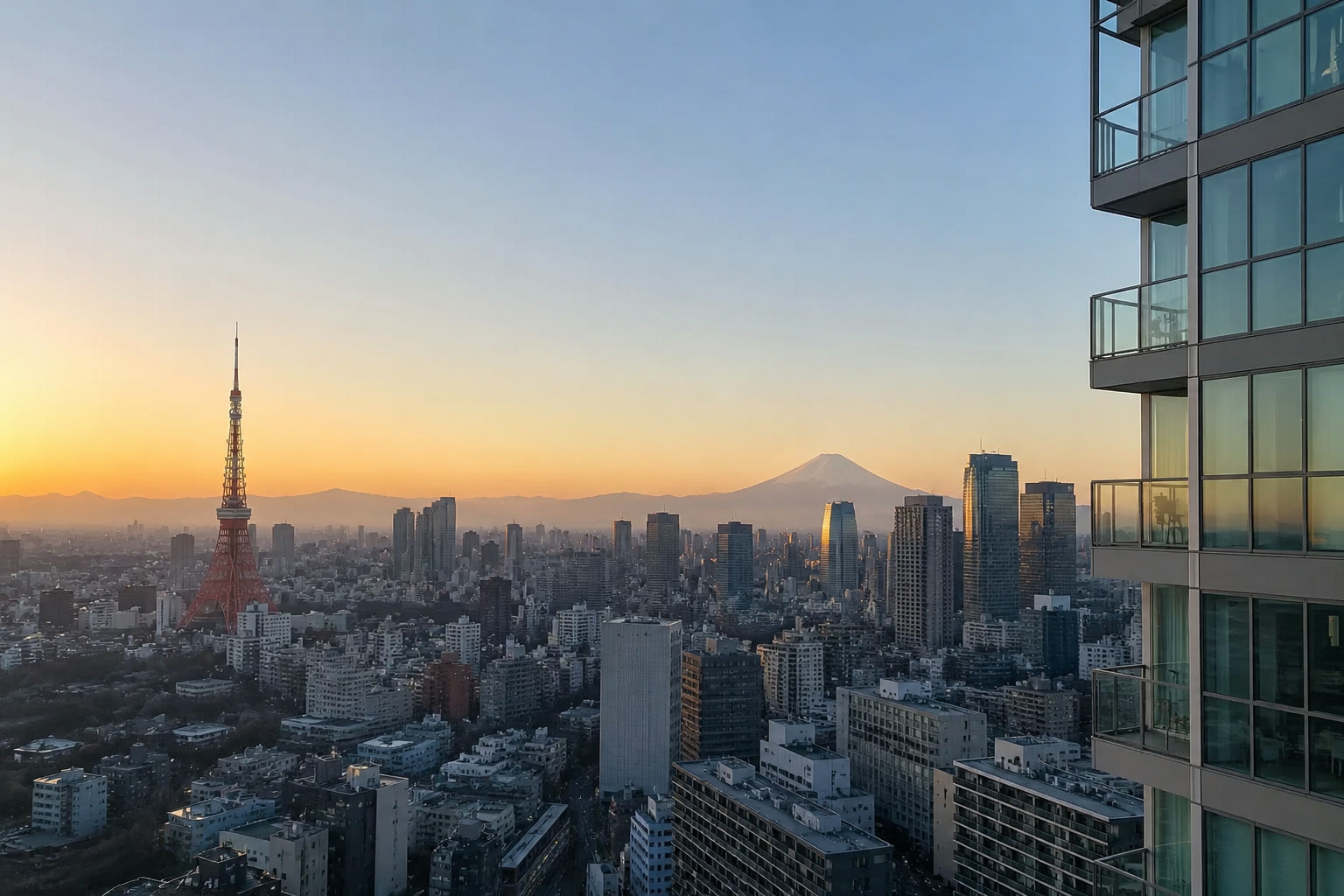
Tokyo’s accommodation market is at a turning point.
On one side, the number of overseas visitors to Tokyo has climbed to record levels.
In 2025 Japan received about 42.68 million international visitors. Tokyo alone welcomed about 28.65 million, a new record, and international visitor spending in Tokyo grew to about JPY 4.55 trillion. Put simply, the demand for places to stay in Tokyo is enormous.
At the same time, minpaku (private short-term rentals) and small lodging facilities have multiplied quickly, mostly in residential neighbourhoods. Noise, rubbish, security and the absence of anyone on site have become visible problems ward by ward, and between 2025 and 2026 regulation across Tokyo’s 23 wards began to tighten fast.
The important point is this:
This is not simply a story of minpaku being banned.
Tokyo has several accommodation regimes that are legally quite different from one another, and the current wave of regulation is beginning to change the value of each of them in very different ways.
One thing to say up front: we are not minpaku specialists or analysts. We own and operate property in Tokyo, and this is our own reading of the published numbers and of where we think this is going.
First, the four types of accommodation business in Tokyo
In everyday conversation all of these may be called “minpaku”, but in law they fall into four broad types.
| Type | Legal basis | Procedure | Operating days per year | Main features |
|---|---|---|---|---|
| Private lodging business (minpaku under the 2018 Act) | Private Lodging Business Act | Notification | Up to 180 days | Uses a “residence”. Ward ordinances can cut operating days further |
| Special-zone minpaku | National Strategic Special Zones Act | Certification | No annual cap | Within the 23 wards, mainly Ota Ward. Minimum stay of 2 nights |
| Simple lodging (kan’i shukusho) | Inns and Hotels Act | Licence | 365 days in principle | Guesthouses, small lodging facilities, whole-building facilities, etc. |
| Ryokan and hotel operation | Inns and Hotels Act | Licence | 365 days in principle | Hotels, ryokan, etc. Strict building, fire safety and sanitation requirements |
A minpaku under the Private Lodging Business Act may operate for up to 180 days in the year running from noon on April 1 to noon on the following April 1 — not 182. Local governments can also shorten those 180 days in practice through their own ordinances.
Simple lodging and ryokan/hotel operation under the Inns and Hotels Act carry no such 180-day limit. Ota Ward’s special-zone minpaku is a separate regime again: guests must stay at least 2 nights, but there is no cap on the number of operating days in the year.
In other words, a “residence” capped at 180 days and a “lodging facility” that can open 365 days are fundamentally different kinds of real estate.
Sources: Japan Tourism Agency, minpaku portal: What is the Private Lodging Business Act? (Japanese) · Ota City, minpaku systems in Ota (Japanese) · Ota City, Q&A on special-zone minpaku certification (PDF, Japanese)
2018 opened the door; 2025–2026 is closing it again
- June 2018 Private Lodging Business Act takes effect — in effect, minpaku is legalised
- 2018 onward Use of the system expands rapidly
- 2025–2026 Shibuya, Sumida, Katsushika, Taito, Toshima, Edogawa and other wards tighten their ordinances one after another
- June 2026 All 23 ward mayors jointly ask the national government to review the private lodging system
The Private Lodging Business Act came into force in June 2018. The policy direction at the time was to let residences be used for paid accommodation under a defined set of rules — in effect, to legalise minpaku. Use of the system then grew quickly.
Between 2025 and 2026 the tide turned. Shibuya, Sumida, Katsushika, Taito, Toshima, Edogawa and other wards tightened their ordinances in succession, and Shinjuku and Ota are considering even stronger rules. In June 2026, all 23 ward mayors jointly asked the national government to review the private lodging system. Their requests include:
- Wider powers for local governments to regulate
- A move from the current notification system to a licensing system with periodic renewal
- A domestic address requirement for overseas operators
- Tighter regulation of management companies
- Regulation of online travel agencies (OTAs) that list illegal properties
The Act has not, as of today, been changed to a licensing system. But it is clear that the policy direction has moved a long way from where it stood in 2018.
Sources: Edogawa City press release: request on the proper operation of private lodging businesses (June 18, 2026) (Japanese) · Request document (PDF, Japanese)
How many minpaku are there in Tokyo’s 23 wards?
As of July 15, 2026, the private lodging businesses in the 23 wards stood as follows.
As of July 15, 2026. Source: Japan Tourism Agency, notification and registration status under the Private Lodging Business Act
Of the 42,070 private lodging businesses operating across Japan, about 40.2% are in Tokyo’s 23 wards — roughly four in every ten of the country’s minpaku sit in one very large market.
More striking still is how concentrated they are. Shinjuku, Sumida, Shibuya and Toshima alone account for 9,760 of them.
That is about 58% of the 16,920 operating in the 23 wards, so a change of ordinance in these four wards alone has a large effect on Tokyo’s minpaku market as a whole.
Operating minpaku, ward by ward
The number of operating facilities as of July 15, 2026:
Show the table by ward (23 wards, official ward order)
| Ward | Operating minpaku |
|---|---|
| Chiyoda | 56 |
| Chuo | 107 |
| Minato | 874 |
| Shinjuku | 3,775 |
| Bunkyo | 327 |
| Taito | 1,373 |
| Sumida | 2,314 |
| Koto | 48 |
| Shinagawa | 242 |
| Meguro | 26 |
| Ota | 254 |
| Setagaya | 546 |
| Shibuya | 1,845 |
| Nakano | 458 |
| Suginami | 440 |
| Toshima | 1,826 |
| Kita | 606 |
| Arakawa | 13 |
| Itabashi | 455 |
| Nerima | 119 |
| Adachi | 278 |
| Katsushika | 394 |
| Edogawa | 544 |
| 23 wards total | 16,920 |
Source: Japan Tourism Agency, notification and registration status under the Private Lodging Business Act, as of July 15, 2026.
Seen this way, it is easy to understand why regulation has become such a large issue in Shinjuku, Sumida, Shibuya and Toshima.
One important fact: minpaku numbers have not fallen yet
This is easy to misread. Despite the tightening, the number of operating private lodging businesses in the 23 wards has continued to rise.
That is 677 more in four months, an increase of about 4.2%. So the claim that
“Tighter regulation has already forced large numbers of Tokyo minpaku to close”
does not match the current statistics. What is happening is a different, and more important, change:
The places where new operators can enter, and the number of days they can legally operate, are shrinking fast.
Source: Japan Tourism Agency, notification and registration status under the Private Lodging Business Act — as of March 13, 2026 (PDF) · as of July 15, 2026 (PDF)
A more important number than facility count: legally sellable nights
Looking only at the number of facilities misses the point when thinking about accommodation supply. What matters more is
facilities × days they can legally operate
A single minpaku that can open 180 days a year and one that can open only 63 days supply very different amounts of accommodation to the market. Expressed simply:
Seen through this lens, the impact of the current regulation becomes very clear.
Shibuya: from 180 days to 63
From July 2026, Shibuya widened the areas in which new private lodging businesses are restricted. Inside those areas, against the national cap of 180 days, a facility can in practice operate only 63 days a year.
63 ÷ 180 = 35%
The same facility, in other words, loses 65% of its legal capacity to supply accommodation. Supply falls even though nothing closes.
Facilities notified by the end of June 2026 are covered by transitional provisions. The rule is therefore designed less to eliminate existing facilities than to sharply restrict new supply — and the result may be that the existing legal stock itself becomes relatively more valuable.
Source: Shibuya City, summary of amendments to the private lodging ordinance and rules (PDF, Japanese)
Toshima: a 120-day cap, including its 1,826 existing minpaku
Toshima goes further. From December 16, 2026, private lodging businesses anywhere in the ward will be limited to
120 days a year
and the 120-day cap applies to existing facilities as well. New area restrictions will also cover about 70% of the ward, including exclusively residential, residential and quasi-industrial zones and school districts.
Toshima currently has 1,826 operating minpaku. If every one of them were using the full 180-day allowance, the legal maximum supply would change as follows:
| Calculation | Legal maximum supply | |
|---|---|---|
| Now (180-day cap) | 1,826 × 180 days | 328,680 facility-days |
| After the 120-day cap | 1,826 × 120 days | 219,120 facility-days |
| Difference | 109,560 facility-days (about 33% less) |
That is a reduction of about 33% in legal supply capacity. Not every operator uses all 180 days, so this is not a forecast of actual guest nights. It is, however, a useful measure of how far the maximum capacity allowed by the system shrinks.
Sources: Toshima City, amendment of the minpaku ordinance (Japanese) · Summary of the amendment (PDF, Japanese)
Sumida: limiting new supply in a market of 2,314 minpaku
Sumida has 2,314 operating minpaku, the largest market after Shinjuku. From April 2026 it introduced a major restriction: in principle, new private lodging businesses may not operate from noon on Sunday until noon on Friday.
New private lodging businesses there effectively become a weekend-centred operating model.
Sumida also changed its rules for inn-licensed lodging, requiring staff to be stationed on site at newly applying facilities. That new requirement applies to facilities applying for a licence on or after April 1, 2026. A gap in regulatory conditions has therefore opened between existing inn-licensed facilities lawfully licensed under the old standards and facilities starting out now.
Sources: Sumida City, regulation of private lodging and inn-licensed businesses (Japanese) · Document 2: current state of private lodging and inn-licensed businesses in Sumida (PDF, Japanese)
Katsushika and Taito are moving the same way
In Katsushika, from April 2026, new private lodging businesses may not operate from noon on Monday until noon on Saturday, in principle. Certain commercial zones and host-occupied homes are exempt, but it is a significant constraint on new residential minpaku.
Taito will restrict weekday operation for newly notified private lodging businesses from October 2026. The ward already has 1,373 operating minpaku, and for inn-licensed lodging it has long applied a very strict requirement for someone to be stationed on site. Despite the huge tourist demand around Asakusa and Ueno, it is no longer a market where new unstaffed lodging can simply be added.
Sources: Katsushika City, old/new comparison of the rules (PDF, Japanese) · Taito City, amendment of the private lodging ordinance (Japanese) · Taito City, partial amendment of the Inns and Hotels Act enforcement ordinance (Japanese)
Shinjuku may matter most for Tokyo as a whole
Shinjuku currently has
3,775
operating minpaku — about 22% of the 16,920 in all 23 wards, in a single ward. The ward has said that by August 2026 notified residences had risen to nearly 4,000 and that it receives more than 1,300 complaints a year. Roughly half of the ward’s minpaku are reported to be in residential zones, and Shinjuku is now considering stronger regulation.
What stands out is that applying the rules to existing facilities is also under consideration. As of September 17, 2026 no ordinance has been finalised. But if operating days were cut sharply for existing facilities too, the impact could be larger than in any other ward.
Source: press report (Sankei Shimbun via Yahoo! News, Japanese). No official Shinjuku City document could be confirmed at the time of writing.
How the regulatory map of the 23 wards is changing in 2026
| Ward | Timing | Main direction | Effect on existing facilities |
|---|---|---|---|
| Shibuya | In force Jul 2026 | Restricted areas widened; new facilities limited to 63 days a year there | Existing generally stay under old rules |
| Sumida | In force Apr 2026 | New minpaku pushed to weekends; on-site staffing rule for inn licences too | Transitional provisions |
| Katsushika | In force Apr 2026 | New minpaku generally cannot operate on weekdays | Existing treated under old rules for now |
| Taito | In force Oct 2026 | Weekday operation restricted for new minpaku | Transitional provisions for existing |
| Toshima | In force Dec 2026 | 120 days a year ward-wide; strong area restrictions across about 70% of the ward | 120-day cap applies to existing too |
| Edogawa | In force Jul 2026 | Stronger local management and operating rules | Depends on individual conditions |
| Shinjuku | Under consideration | Major restrictions considered, focused on residential areas | Applying to existing also under consideration |
| Ota | Amendment under consideration | Tighter management rules for both minpaku and inn-licensed lodging | Partial application to existing expected |
Tightening is not happening in one ward only. It is a structural change spreading across all 23 wards.
How much licensed lodging does Tokyo have?
Now look beyond private lodging businesses to the facilities licensed under the Inns and Hotels Act. At the end of FY2024, the 23 wards had:
End of FY2024, Tokyo’s 23 wards. Source: Tokyo Metropolitan Government, Tokyo Statistical Yearbook
That is 6,121 licensed lodging facilities in total, against 16,920 minpaku as of July 2026. Comparing facility counts alone:
A single hotel can have tens or hundreds of rooms, though, so facility counts cannot be read directly as accommodation supply. The point is that
Tokyo’s accommodation market combines a very large number of small residential minpaku with licensed lodging facilities that can operate 365 days a year.
Minpaku, simple lodging and ryokan/hotels by ward
Setting the public statistics we were able to confirm side by side:
| Ward | Operating minpaku July 2026 | Simple lodging End of FY2024 | Ryokan / hotels End of FY2024 |
|---|---|---|---|
| Chiyoda | 56 | 17 | 140 |
| Chuo | 107 | 17 | 209 |
| Minato | 874 | — | — |
| Shinjuku | 3,775 | 52 | 511 |
| Bunkyo | 327 | 7 | 43 |
| Taito | 1,373 | 205 | 675 |
| Sumida | 2,314 | — | — |
| Koto | 48 | 16 | 223 |
| Shinagawa | 242 | 23 | 166 |
| Meguro | 26 | 4 | 62 |
| Ota | 254 | 22 | 107 |
| Setagaya | 546 | — | — |
| Shibuya | 1,845 | 18 | 462 |
| Nakano | 458 | 30 | 161 |
| Suginami | 440 | 8 | 100 |
| Toshima | 1,826 | — | — |
| Kita | 606 | 114 | 36 |
| Arakawa | 13 | 31 | 62 |
| Itabashi | 455 | 7 | 77 |
| Nerima | 119 | — | — |
| Adachi | 278 | 14 | 75 |
| Katsushika | 394 | 29 | 306 |
| Edogawa | 544 | 6 | 80 |
| 23 wards total | 16,920 | 755 | 5,358 |
Sources: minpaku from the Japan Tourism Agency; licensed lodging from the Tokyo Statistical Yearbook.
“—” does not mean zero. It marks wards for which the breakdown by category could not be confirmed from the extract of Tokyo statistics we used; those facilities are included in the 23-ward totals.
For reference, Sumida’s own ward documents report that its licensed lodging facilities had grown to 753 in total by the end of FY2024 — a sign, in that ward alone, of how quickly the accommodation business has expanded.
What these numbers show
A very interesting pattern emerges. Minpaku are most numerous in
— and these are exactly the areas where regulation is tightening. It seems closer to the reality to say that the wards are not trying to suppress demand for accommodation itself, but are
tightening the constraints on a model that converts large numbers of homes into short-term stays.
The demand for accommodation does not disappear. It is absorbed instead by
- Hotels
- Simple lodging
- Existing ryokan
- Legally compliant whole-building lodging
How many minpaku will disappear?
That cannot be said with certainty yet. If anything, minpaku numbers were still rising through the first half of 2026, so it would not be appropriate to forecast that “several thousand will close”.
What can be calculated is how much supply capacity may be lost. In Toshima, if the legal cap on the existing stock of 1,826 falls from 180 days to 120, that is about 33% less on a maximum-operating-day basis. For new facilities in Shibuya’s designated areas, 180 days become 63 — about 65% less. In Sumida, Katsushika and Taito, new private lodging businesses are confined to weekend- and holiday-centred operation.
To read the market from here on, we think the question itself has to change.
Even when the number of facilities holds steady, the nights that can legally be sold keep falling.
Why running a minpaku in Tokyo has got harder
That is the regulation. On the ground, it has got harder for a simpler reason first: a great many people rushed to open minpaku before the rules arrived, and supply has run ahead of demand.
Inbound demand in Tokyo is not falling, and we find it hard to imagine foreign demand falling from here. But Japan–China relations and visa issues have reduced Chinese visitor numbers somewhat. The result is that a fair number of minpaku are not reaching the bookings their operators assumed, and are not making money as things stand.
Competition has intensified as well. In the early days, individual investors took ordinary residential leases and sublet the units for short stays. The barrier to entry was low and there were still few properties, so there was a good window for getting in. Simply put, too many players have now entered.
Leasing and subletting is losing its edge
On top of that, several problems have come to the surface:
- Amateur, half-finished operation producing complaints and trouble
- Landlords raising rents at renewal, or fixed-term leases that are hard to renew at all, or impossible to renew on the same terms
- Well-capitalised, genuine investors entering, complying properly with the law, and offering lodging of a higher standard in both building condition and service
Guests who were once satisfied simply because it was cheaper than a hotel now expect more, and operators have no choice but to meet a higher standard. With a leased property, though, there is always the uncertainty of how much cost and investment you can justify putting into something you do not own. For that reason the competitive advantage of lease-based minpaku has fallen, and the market is moving to more professional hands.
Licensing is tightening too, and in some cases rules applied retroactively can stop an operation that was previously fine. This is becoming a business that needs a proper licence under the Inns and Hotels Act, along with a high level of knowledge and management capability.
We suspect the only operators left will be those with real capital, who own good buildings themselves and are in it for the long haul — not a hit-and-run business.
That, at least, is how we see it at the moment.
And beyond that, a scarce asset
All of this points to the kind of hospitality real estate that may become scarce. It is not simply “a property with an inn licence”. What matters more, we think, is a property that meets these conditions:
-
1
It already holds an inn licence
It can operate 365 days a year in principle, rather than within the 180-day allowance for private lodging.
-
2
The whole building can be owned
Entrances, a management office, fire safety equipment and guest circulation can be controlled directly, without depending on a condominium management association or other unit owners.
-
3
It complies with building, fire and inn-licensing rules
Not only does a business licence exist, but the building and fire-safety compliance it rests on can be confirmed.
-
4
It can be staffed if that is required in future
A management office or front desk can be installed, and the business still works with staff on site.
-
5
The licence and business can pass to the next owner
Under the 2023 amendment to the Inns and Hotels Act, the status of operator can be succeeded through a business transfer with prior approval from the authorities.
At first sight it is tempting to think that wards tightening their rules should be avoided as places to invest. For existing stock, we think the opposite view is also possible. Take Sumida. It currently has 2,314 private lodging businesses. The days on which new minpaku can operate have been sharply limited, and new inn-licensed facilities now carry an on-site staffing requirement. Yet for inn-licensed facilities already operating lawfully under the old standards, the new staffing requirement does not, in principle, apply retroactively.
building the same thing from scratch has become harder than it used to be.
So in valuing an existing inn-licensed property, it is not enough to look at how much it cost to obtain the licence. The more important question, as we see it, is whether a facility with the same earnings structure could be built again, on the same site, today. If new ordinances require a building that has yet to be licensed to provide staff on site, a management office, a front desk, explanations to neighbours and new fire safety equipment, then it may no longer be possible to match a whole-building inn licensed under the old standards and operating 365 days a year at the same operating cost.
Source: Ministry of Health, Labour and Welfare, amendment of the Inns and Hotels Act (Japanese)
Why owning the whole building matters
Here there is a large difference between a single-unit inn and a whole-building inn. In a condominium unit, the owner cannot freely change the shared entrance, the corridors, the lifts, the emergency stairs, the management office or the space a front desk would need. So if rules are introduced in future requiring staff to be stationed inside the facility, or separating the routes used by guests from those used by residents, it may be physically impossible to comply.
Toshima has in fact identified the growth of single-room inns as a problem. Its licensed lodging facilities had grown to 510 by 2026, about 70% more than in FY2024, and complaints about inn-licensed lodging rose to 80 in FY2025, roughly four times the previous year. The ward is therefore considering amending its ordinance to introduce an on-site staffing requirement for inn-licensed lodging as well.
With a whole building, by contrast, the owner can create a management office, station staff, change the entrances, add security cameras, add fire safety equipment and change guest circulation. That freedom is itself a source of future value, we think.
Source: Toshima City, mayor’s address to the 2nd regular ward assembly session of 2026 (Japanese)
How we see it, and what we are looking at
Seen that way, we continue to watch for a chance to enter the licensed lodging business ourselves, and we keep looking at buildings with that in mind. Leasing a property in order to sublet it is not something we are considering at present.
What we do want to introduce as brokered listings are properties that meet the conditions set out above: an inn licence properly held, a building that stands up on the building-code and fire-safety side, a Tokyo location with real accommodation demand, and the ability to operate 365 days a year. We currently handle several whole-building properties in Tokyo that combine all four.
This is not to say that any particular ward is safe. Circumstances differ from building to building even within the same ward, and ward rules are still moving. What matters is not the name of the ward but whether that specific building meets the conditions.
With properties like these, the headline yield alone is not enough. Alongside the land and the building, we look at the existing inn licence, the operating track record, and whether the facility could keep trading if the rules change again.
Tokyo’s accommodation market is at a turning point
It would not be right to read the current tightening as the end of minpaku. Numbers in the 23 wards were still rising in the first half of 2026. Behind that, however, operating days are being shortened, new entry in residential areas is being closed off, explanations to neighbours are becoming more demanding, manager requirements are becoming stricter, and the rules are reaching unstaffed inns as well.
legal accommodation supply will gradually consolidate away from lightly regulated homes and into lodging facilities with proper management responsibility, building and fire compliance, and operating systems.
In that process, what matters is not only whether a new licence can be obtained, but whether an existing, lawful lodging facility can be acquired.
International visitors to Japan now exceed 40 million, and Tokyo alone receives about 28.65 million. Tokyo’s 23 wards have about 16,900 minpaku and about 6,100 licensed lodging facilities, and about 58% of those minpaku are concentrated in just four wards — Shinjuku, Sumida, Shibuya and Toshima. Those same wards are now tightening their rules at the same time.
Given that structure, what may hold value from here is not simply “property that can be used for minpaku”. We think it is more likely to be existing, lawful whole-building lodging facilities that keep the ability to operate 365 days a year while creating the same thing anew becomes steadily harder — and that this difficulty of replacement matters most in the wards where rules on new entry are tightening fastest.
An inn licence does not, of course, guarantee that an asset will rise in value. Location, purchase price, building and fire compliance, management costs, the economics of a staffed operation and whether the licence can be succeeded all need to be checked property by property. But in thinking about hospitality real estate in Tokyo, we think the question is shifting:
That perspective will matter more than ever, and it is what we see beginning to form in Tokyo’s hospitality real estate:
regulatory scarcity.
Properties that started out simply, and that fall short on operating set-up, building quality or service level, will be weeded out fairly quickly from here. The minpaku and lodging market is, we think, at a real turning point right now.
Considering Income Property in Tokyo?
We think through the acquisition, ownership and operation of income property with you, based on your own circumstances.
View Properties Contact AOKI LIVING →Main Sources
Notified residences by ward (as of March 13 and July 15, 2026)
Overview of the Private Lodging Business Act (180 days a year, counted from noon on April 1)
International visitor arrivals (2025 annual estimate)
International visitors to Tokyo and their spending in 2025
Environmental sanitation business facilities (end of FY2024)
Comparison of special-zone minpaku, private lodging and inn licences; outline of ordinance amendments
Ordinance amendments on private lodging and inn-licensed businesses in each ward
Request on the proper operation of private lodging businesses (June 18, 2026)
Succession of operator status through business transfer (in force December 13, 2023)
No official Shinjuku City document could be confirmed at the time of writing, so a press report is cited.
This article is based on laws, municipal documents and statistics published as of September 17, 2026. Ordinances, licences, transitional provisions and operating conditions differ by location, application date and type of operation. For any individual property, confirmation with the relevant public health centre and the building and fire authorities is required. This article is provided for general information only and does not constitute investment, legal or tax advice.