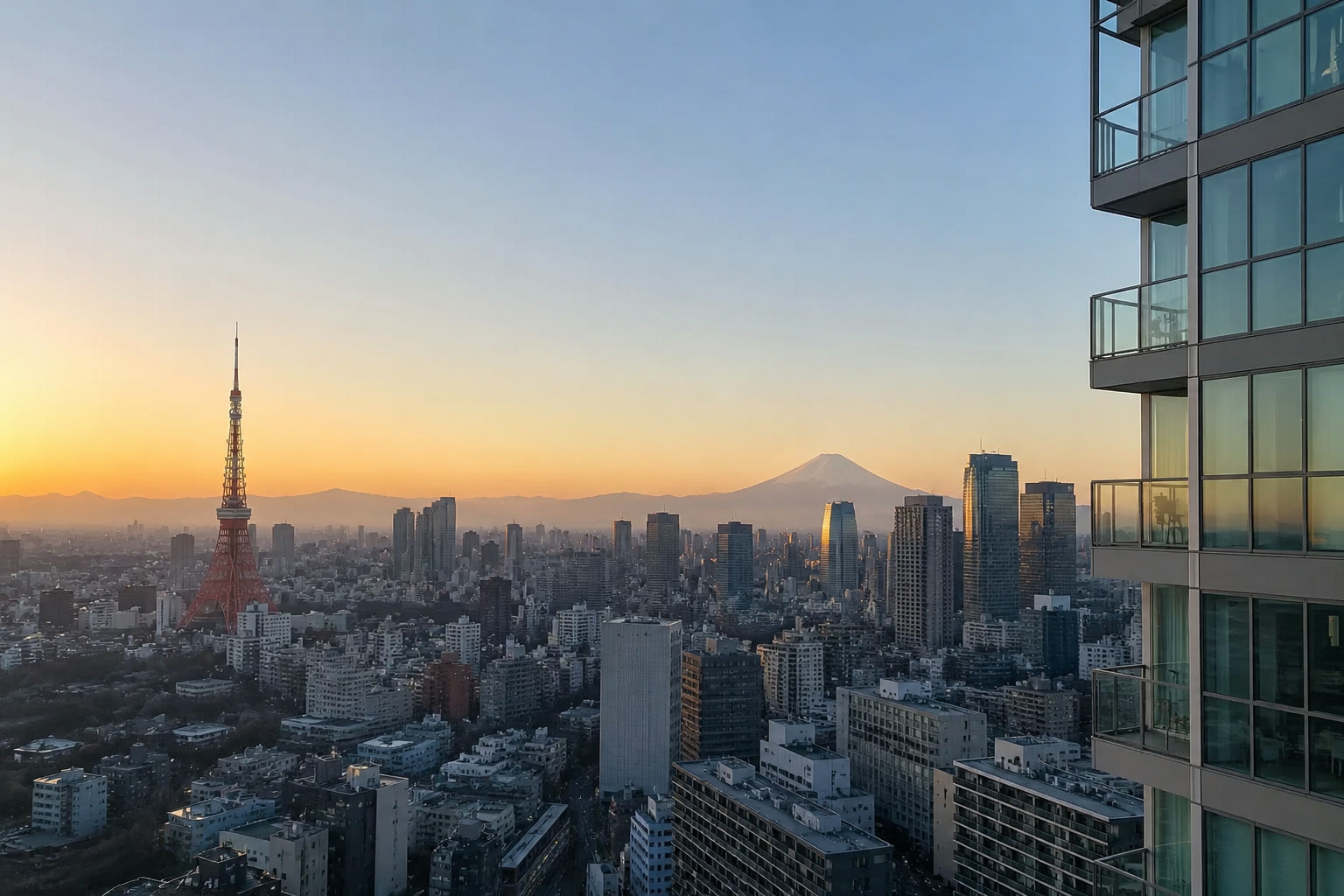
Tokyo property has become considerably more expensive over the past decade. The more important question is why.
This is not simply a story of buyers paying more for the same assets. The cost of creating new housing has changed. Land is more expensive, construction costs are higher, and new condominium supply has fallen to historically low levels. At the same time, people, employment and capital continue to concentrate in Tokyo and its strongest commuter markets.
These forces are changing the value of existing residential property—particularly assets in locations that are difficult to reproduce.
Four numbers behind the shift
The average transaction price per square metre rose for a 13th consecutive year.
Commercial land prices in the 23 wards rose by approximately 13.8%.
Average rents were approximately 43% higher than in 2016.
One of the lowest annual supply levels since comparable records began in the 1970s.
A price increase supported by completed transactions
Average new condominium prices can be distorted by the release of a small number of expensive tower and redevelopment projects. For that reason, asking prices and headline averages should not be read in isolation.
Completed transactions provide a clearer picture.
East Japan REINS reported that the average transaction price of a pre-owned condominium in Greater Tokyo reached approximately JPY 829,800 per square metre in 2025, up 7.9% year on year. It was the 13th consecutive annual increase.
Around ten years earlier, the corresponding figure was approximately JPY 440,000 to JPY 450,000 per square metre.
The increase has therefore been substantial even outside the new-build market.
The cost of replacing property has changed
A well-located pre-owned condominium is often described mainly by its age.
That is only half of the equation.
The other question is what it would cost to acquire the land and construct the same building today.
Japan’s construction-cost indicators have risen by approximately 30% over the past decade, while central urban land has also become more expensive. A building completed ten or fifteen years ago may therefore have been created under cost conditions that no longer exist.
This does not make every older building valuable. Building management, repair reserves, seismic standards and physical condition remain critical.
But where the location is strong and the building has been properly maintained, rising replacement costs make equivalent new supply harder to deliver at a competitive price.
Source: Ministry of Land, Infrastructure, Transport and Tourism, Construction Cost Deflator.
Land is doing more of the work
The 2026 official land-price survey recorded an increase of approximately 9.0% for residential land in Tokyo’s 23 wards and 13.8% for commercial land.
The wider metropolitan area also remained positive, although the pace differed by region. The research data showed residential-land increases of approximately:
The point is not that every location is rising at the same rate. It is that capital is concentrating in places with strong transport, employment, redevelopment and residential demand.
For a condominium owner, land is held indirectly through the unit’s share of the site. That land component helps explain why two buildings of similar age and specification can perform very differently.
A short walk to a major station, access to several railway lines, established neighbourhood demand and limited competing supply are not merely lifestyle benefits. They are part of the asset.
Official land-price data. Geographic coverage and market composition differ by region.
Source: Ministry of Land, Infrastructure, Transport and Tourism, 2026 Official Land Price Publication.
Limited supply is supporting existing stock
Greater Tokyo supplied approximately 21,600 new condominiums in fiscal 2025, one of the lowest levels since comparable records began in the 1970s.
This is not simply a developer preference.
Land acquisition has become more difficult. Materials and labour cost more. Construction periods are longer, and projects need higher selling prices to remain viable.
As a result, developers are concentrating on sites and projects that can support premium pricing. Moderately priced new housing in central and well-connected locations has become harder to deliver.
That changes the position of existing property.
A well-managed pre-owned condominium is no longer simply the cheaper alternative to a new unit. It may offer access to a location, scale and neighbourhood that new development can no longer reproduce at a similar price.
Source: Real Estate Economic Institute, Greater Tokyo New Condominium Market Trends, Fiscal 2025.
Rising rents show that demand is not only financial
Price growth is more persuasive when it is supported by people who actually need housing.
Tokyo’s average condominium rent reached approximately JPY 4,544 per square metre in 2025, an increase of around 9.2% from the previous year. Compared with 2016, the average was approximately 43% higher.
Contract-rent indices also rose across Tokyo and the strongest commuter markets. The research recorded year-on-year increases of approximately:
This distinction matters. Advertised rents show what owners hope to receive. Contract-rent data is closer to what tenants are actually agreeing to pay.
At Home’s published rental data also showed that, by the end of 2025, condominium rents were above the previous year across every measured Greater Tokyo region and apartment-size category. Tokyo’s 23 wards had recorded repeated highs across multiple segments.
Quality-adjusted contract-rent indices · year-on-year growth by late 2025
Sources: Tokyo Kantei and At Home Co., Ltd.
Tokyo is becoming more important within Japan
Japan’s national population is declining. Tokyo is moving in a different direction.
As of January 1, 2026, Tokyo’s registered population stood at approximately 14.08 million, an increase of about 75,000 from the previous year. The foreign population reached 783,701, up 8.66% year on year.
The age profile is also relevant. Among Tokyo’s foreign residents, the largest five-year age group was 25 to 29.
Tokyo continues to absorb people in the years when they are most likely to study, work, rent homes and form households.
That does not guarantee permanent population growth. It does show why Japan’s national demographic trend should not be applied mechanically to Tokyo housing.
Employment, universities, transport, corporate headquarters and international communities remain concentrated in the capital. Residential demand follows that concentration.
Sources: Tokyo Metropolitan Government, Population and Households, January 1, 2026; Tokyo Metropolitan Government, Foreign Population Statistics.
Greater Tokyo is not one uniform market
The upward movement is spreading beyond central Tokyo, but selectively.
In the second quarter of 2026, pre-owned condominium prices per square metre were reported to have increased year on year by approximately:
Quarterly data can be volatile.
Quarterly figures can move sharply, so these numbers should not be treated as a forecast.
They do, however, show that demand is not confined to the centre of Tokyo. It is extending into major cities and transport corridors that remain closely connected to the capital.
The more defensible locations tend to share the same characteristics:
- 1. A short walk to a major station
- 2. Direct access to central Tokyo
- 3. More than one source of tenant demand
- 4. Active commercial or infrastructure investment
- 5. Professional building management
- 6. A broad future resale market
Yokohama, Kawasaki, Musashi-Kosugi, Ichikawa, Funabashi, Urayasu, Omiya and Urawa can all fit this pattern—but not every property within those cities will.
The dividing line is increasingly specific: station, street, building and management quality.
Source: East Japan REINS, Market Statistics Library.
What long-term owners should take from this
The investment case is not simply to buy property because it is located in Tokyo.
It is to own property that will remain difficult to replace.
That usually means a combination of:
- Scarce or valuable land
- Strong station access
- Real tenant demand
- Sound building management
- Adequate repair reserves
- A credible resale market
A property with these attributes can benefit from several forces at once: rising land values, constrained new supply, higher replacement costs, stronger rents and deeper liquidity.
A property without them may underperform even while the wider market is rising.
Scarcity is becoming part of the value
Tokyo residential property is not merely becoming more expensive. The cost and difficulty of creating equivalent housing have changed.
Land is higher. Construction is more expensive. New supply is limited. Rents are rising, and people and capital remain concentrated in the strongest urban locations.
None of this guarantees future appreciation.
It does mean that well-located and properly managed residential property is becoming harder to reproduce.
For a long-term owner, that scarcity is increasingly part of the asset itself.
Review Greater Tokyo Opportunities
Explore selected residential and income-property opportunities in Tokyo and the surrounding metropolitan region, with attention to location, ownership structure, management and long-term value.
View Properties Request a Private ConsultationSources & Data Notes
Pre-owned condominium transaction prices, long-term trends and regional quarterly market data.
Official land-price data and construction-cost indicators.
Greater Tokyo new-condominium prices and supply.
Annual condominium-rent data and long-term rental trends.
Tokyo Kantei — Annual Condominium Rent Trends, 2025
Rental asking-price trends and metropolitan market data.
Tokyo population and foreign-resident data.
Figures are drawn from published market data available at the time of preparation. Definitions, geographic coverage and reporting periods differ between publishers, and figures may be revised. Quarterly figures may be more volatile than annual data.
This article is provided for general information only and does not constitute investment, legal, tax or financial advice. Property prices, rents, interest rates and exchange rates may rise or fall. Past performance does not guarantee future results. Each property should be assessed individually based on its location, condition, management, ownership structure and the investor’s circumstances.