We gather data objectively from the latest available sources and share what we find useful.
We hope it helps anyone looking for a home in Japan, or considering a business built around property.
A rental property earns in four ways, and Tokyo offers all four on balanced terms.
Yield comparisons usually look only at the rent. For a long-term owner, the rent is the first of four sources of return:
- Monthly income. Rent arrives every month, and what remains after running costs is the owner's cash return.
- Land value growth. The land under the building can appreciate, and in central Tokyo it has been doing so strongly (figures below).
- Rent growth with inflation. With Japan back in an inflationary environment, rents can be revised upward over time at renewal and re-leasing.
- Equity from mortgage repayment. Where a loan is used, each repayment increases the owner's share of the property, paid for largely by the tenant's rent. Japanese borrowing costs make this unusually favourable.
Together they make residential property one of the most dependable ways to build wealth over time.
Land Prices and Rents in Central Tokyo
The 2026 official land price survey showed double-digit rises across central Tokyo. Year-on-year change, in the five central wards and across the 23 wards:
| Ward | Residential | Commercial | All uses |
|---|---|---|---|
| Minato | +16.6% | +14.0% | +15.0% |
| Chuo | +13.8% | +13.5% | +13.5% |
| Shinjuku | +11.2% | +13.8% | +12.9% |
| Shibuya | +11.0% | +13.8% | +12.5% |
| Chiyoda | +10.7% | +13.1% | +12.8% |
| All 23 wards | +9.0% | +13.8% | +11.1% |
Source: Tokyo Metropolitan Government, 2026 official land prices (as of 1 January 2026), average change by ward and use.
Rents are rising too. In the condominium rent index published by At Home and Sumitomo Mitsui Trust Research Institute, rents across the 23 wards rose 6.7% year on year in January–March 2026: 8.1% for single units (18–30 sqm), 5.6% for compact units (30–60 sqm) and 12.3% for family units (60–100 sqm). The public release does not break rents down by ward.
How Japan's Yields Compare
The usual starting point is the gross yield: a year's rent divided by the price, before costs. Global Property Guide's latest survey, based on median apartment prices and rents in each country's main cities, puts Japan at 4.55%.
| Market | Gross rental yield |
|---|---|
| United Kingdom | 7.35% |
| United States | 6.71% |
| Australia | 4.94% |
| France | 4.83% |
| Japan | 4.55% |
| Hong Kong | 3.55% |
| Germany | 3.35% |
| Singapore | 3.06% |
| Switzerland | 2.91% |
| Taiwan | 2.26% |
Japan earns noticeably more rent per yen invested than the other Asian financial centres and the core markets of continental Europe. Yields in the United States and the United Kingdom are higher on paper, but they come with much higher borrowing costs. Japan combines a mid-range yield with low interest rates and the same ownership rights for foreign buyers as for Japanese buyers.
What an Owner Keeps After Costs
A gross yield is the rent before running costs. Management fees, fixed asset tax, insurance, a vacancy allowance, leasing costs and small repairs come out first. In our illustrations for a JPY 100 million purchase with no financing, a prime Tokyo condominium advertised at 3.5% keeps about 2.0% after these costs, a near-new steel-frame building in a prime Tokyo location at 5.0% keeps about 3.7%, and a selected building in Greater Tokyo at 6.5% keeps about 4.7%.
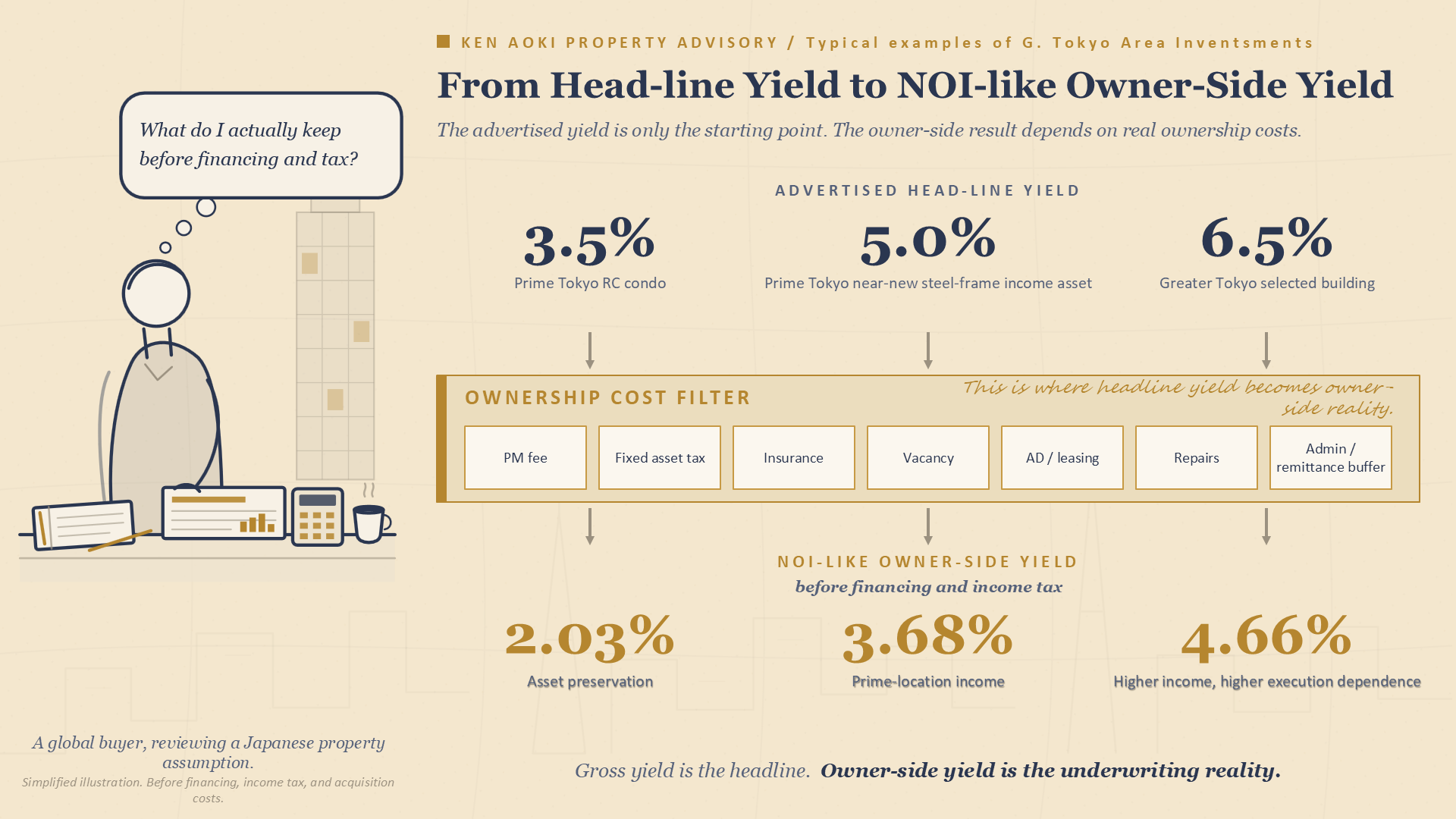
These figures are the return from rent alone. Add land value, rent growth and, where a loan is used, the equity built by repayment, and the full picture is considerably stronger. The prime condominium earns less in rent but is usually the easiest to hold and to sell; the higher-yield building earns more income and rewards careful selection. Each has its place, depending on what the owner wants the property to do.
Borrowing Costs, and Why Cash Buyers Are Active
Interest rates in Japan remain low by international standards. As of September 2026, ordinary home loans are typically around 1.0–1.5%, and loans for investment property generally around 1.5–3.5%. For investors in particular, the rate depends heavily on the borrower's own profile. People buying a home to live in are especially well served.
Typical ranges as of September 2026. Actual terms depend on the lender and the borrower.
A simple way to read a financed purchase is to take the return after costs and subtract the interest: what remains is the cash an owner can expect from the property. The principal repaid each month is not a cost but equity, the fourth source of return above.
Overseas buyers paying in cash have been particularly active in Tokyo. The yen is historically weak, so prices look modest in their own currency, and a cash buyer does not need to think about interest rates at all. That combination has drawn buyers to high-quality properties in prime locations.
Tokyo remains one of the deepest rental markets in the world, with steady demand from a large working population. For an overseas owner who wants income today and a stronger asset over time, it is a market worth serious consideration.
Frequently Asked Questions
What is the average rental yield in Japan compared with other countries?
Global Property Guide's September 2026 survey puts Japan's gross rental yield at 4.55%, above Hong Kong (3.55%), Germany (3.35%), Singapore (3.06%), Switzerland (2.91%) and Taiwan (2.26%), and below the United Kingdom (7.35%), United States (6.71%), Australia (4.94%) and France (4.83%). Yields in the US and UK come with much higher borrowing costs.
What is the net yield on a Tokyo rental property after costs?
In our illustrations for a JPY 100 million purchase with no financing, a prime Tokyo condominium advertised at 3.5% keeps about 2.0% after costs, a near-new steel-frame building in a prime Tokyo location at 5.0% keeps about 3.7%, and a selected Greater Tokyo building at 6.5% keeps about 4.7%. Management fees, fixed asset tax, insurance, vacancy allowance, leasing costs and small repairs come out first.
What are mortgage interest rates in Japan for property investors?
As of September 2026, ordinary home loans in Japan are typically around 1.0–1.5%, and loans for investment property generally around 1.5–3.5%. For investors in particular, the rate depends heavily on the borrower's own profile, and actual terms depend on the lender and the borrower. Interest rates in Japan remain low by international standards.
How much have Tokyo land prices and rents increased in 2026?
The 2026 official land prices (as of 1 January 2026) showed all-use rises of 15.0% in Minato, 13.5% in Chuo, 12.9% in Shinjuku, 12.5% in Shibuya, 12.8% in Chiyoda and 11.1% across the 23 wards. Condominium rents across the 23 wards rose 6.7% year on year in January–March 2026, including 12.3% for family units of 60–100 sqm.
Can foreigners buy property in Japan, and how does a rental property make money?
Japan gives foreign buyers the same ownership rights as Japanese buyers. A rental property earns in four ways: monthly rent after running costs, land value growth, rent growth with inflation at renewal and re-leasing, and, where a loan is used, equity built as each repayment increases the owner's share of the property.
Sources
General information only, not legal, tax or investment advice.